
 Our annual survey of Aotearoa New Zealand's school libraries is open again. The annual surveys are a project that began in 2018 with partners National Library of New Zealand and Library and Information Association of New Zealand Aotearoa (LIANZA), with reports on the data spanning 5 years – and growing! The information that you provide gives us insights that help us prioritise, plan, and deliver our services. It’s also very valuable information to HELP US – and YOU! – advocate for school libraries and your role. Over the years, NLNZ Services to Schools have been able to provide information that school library staff have used to successfully advocate for improved staff hours and collection budgets. It’s important that we continue collecting and sharing this information, and that we have as many responses as possible, to build a comprehensive understanding of the valuable role of school libraries and the people who work in them. The survey's easy to complete, and you can choose which sections you’ll answer. This year we’ve provided more flexibility for school library staff about which questions you’ll see in the survey – but we still encourage you to complete as many as you can! The 2023 survey asks about:
- your job as a library staff member specifically - your current and future employment - your expertise, qualifications and professional memberships - and ongoing professional development and support in your role
- future changes to your collection - collection development funding levels and sources. Click here to find out more and start the survey
0 Comments
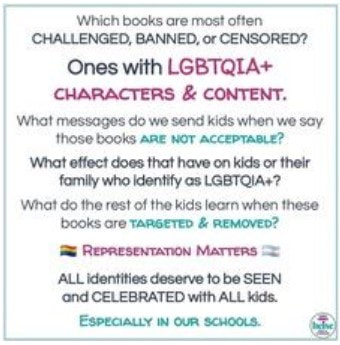
  During April 2023 we held a ‘discussion’ event in our Facebook Connected Community Group - What is book banning? Has it arrived in Aotearoa and what can we do about it? An online discussion. Whilst SLANZA doesn’t believe that ‘book banning’ is prevalent in Aotearoa New Zealand we are nonetheless concerned that this serious matter is quickly developing overseas and about the increasing media around this topic. We are mindful that we need to be ready in case these types of challenges increase in the wider library sector here in Aotearoa New Zealand. Here are the articles, links and resources shared during our discussion in April together with more recent articles: Useful resources:
Further reading:
 Questions prepared by LIANZA and SLANZA were sent to New Zealand political parties to answer before the election in October 2023. They included key questions for the sector. We have showcased the school library specific questions and responses below.
You can read all the questions relating to the wider library sector here: 2023 Election questions for library and information sector Equitable access to school libraries There is no requirement or specialised funding for schools in Aotearoa New Zealand to provide library spaces, services or staff. This means most students don’t have access to a school library run by a school librarian, even though only 64.6 percent of 15-year-olds in Aotearoa New Zealand have basic proficiency in reading and maths (UNICEF, 2020), and “reading for pleasure is the single biggest indicator of a child’s future success, more than family circumstances, parents’ educational background or income” (OECD, 2002). A survey of all Aotearoa New Zealand schools highlighted that a library is essential for promoting and supporting reading for pleasure, achieving literacy standards, strengthening inquiry learning and teaching and enhancing students’ social and emotional learning and well-being (National Library of New Zealand, n.d.). What will your party do to address the inequitable access of Aotearoa New Zealand primary and secondary students to a school library staffed by a qualified librarian? The Green Party Libraries are a crucial part of school communities and foster curiosity and ideas in the minds of Aotearoa’s future generations. The Green Party is committed to ensuring Aotearoa’s schools, both primary and secondary, have access to a school library staffed by a qualified librarian. We support adequate and targeted funding so primary and secondary students have access to library services. The ACT Party ACT shares the horror at collapsing literacy standards in New Zealand. ACT’s solution is to have equity-based funding per student to attend the schools they and their parents want. It should be for individual schools and their boards to make decisions on what is best for their school. The Labour Party We recognise the important work of school librarians and library assistants and that is why as a Government we agreed to a historic pay equity settlement signed in March this year. For school librarians and library assistants, the new pay equity rates will see them receive average pay increases of approximately 10 to 38 percent. Perhaps even more important is the message this settlement sends when you look beyond pay, as it raises the mana of these roles. Despite the benefits of school libraries and librarians, it is important that schools have the flexibility to decide the best use of their resources, to respond to their particular needs, community aspirations and circumstances. These vary greatly. This variability of needs and priorities is why boards have discretion over how they use their operational funding, the people they employ, and the mix of teaching, library and non-teaching spaces. All schools receive resourcing, including for buildings, that can be used to provide a library space, and Ministry of Education data shows most schools have some kind of library or library collection. But mandating the use of space for a library would be a significant departure from how the system currently works. Consistency of resources is not necessarily as important as having the right resources for each school, to best support students to be present, participating and making progress. For example, a very small school may be better to partner with a community library than incur the significant fixed costs associated with having its own library. With a big increase in equity funding this year, and better targeting of that funding, there may well be schools that are now able to invest more in their libraries in ways that help overcome socio-economic barriers to participation and achievement. The National Party Falling literacy rates across the country is one of the key focusses for the National Party, and this has led to the Teaching the Basics Brilliantly policy, which calls for at least one hour of reading, writing and maths every day. Erica and the National Party agree that we need to foster reading in schools as this is the clearest indicator of success for students. It is a concern that students do not have equal access to libraries and books and this is an area that Erica and the National Party would look into if elected. Undoubtedly having access to libraries and librarians is part of the solution for lifting literacy rates across the country. While the National Party are not in the position to make any definitive statements of policy at this stage, this is an area that they will be carefully reviewing and appreciate the information around the benefits of libraries and qualified librarians.  Take part in the 2023 Softlink School Library survey! #2023SLS. The Survey is your opportunity to have a say on the trends and issues facing school libraries and is open to all schools in Aotearoa New Zealand. Survey closes 20 Oct, 2023. Go to survey or learn more
https://www.softlinkint.com/blog/2023-school-library-survey-australia-and-new-zealand/  It is with pleasure that we introduce our new Manukura (President), Claudine Crabtree. You may know Claudine as the Tāmaki Makaurau/Auckland National executive representative. She has held this role for two years. Below is an introductory speech that Claudine presented at our AGM: Ko Maunga-taniwha te maunga Ko Tapapa te awa Ko Ngātoki-mata-whau-roa te waka Ko Ngāpuhi te iwi Ko Te Uri Mahoe te hapū Ko Mangamuka te marae Ko Otene te whanau Ko Claudine Crabtree takou ingoa. Just in case you are wondering who I am and what on earth I’m doing here I thought I would briefly fill you in... I live and work in Auckland, I’m married to Nick and we have 2 boys, Sam 19 and Ben 14, a dog called Phoebe and 2 cats. Apart from books and reading, I am an admirer of fashion, I love shopping and I love dancing. I started my working life in the corporate world as an E.A. or Executive Assistant to company CEO’s and MD’s. I took time off to travel with my husband who was sailing professionally so we lived overseas for a few years before returning to Aotearoa to have our 2 boys. With my husband's role in the sailing industry we moved to the UK in 2010 and in 2014 I started working at the Junior school my son was at in the library. I loved it and knew I had finally found my “thing”. Libraries and books have always been my happy place, so connecting young people to these is a dream come true for me. Currently I am Library Manager at Baradene College in Auckland. I think I have the best job in the whole world. I think being a school librarian is one of the most important jobs in education. And I want everyone else – pupils, parents, principals, politicians and the press to know that too, and to know the value and importance of school librarians and libraries in schools.  This is why I joined SLANZA, why I volunteered to take on a National Executive role 2 years ago and why I put my hand up to become President. SLANZA started over 20 years ago and there have been many Presidents and N.E. members in that time – to all those volunteers for your time, effort, dedication, passion, tears and laughter (hopefully!) we acknowledge and appreciate we are here today because of you. We have an amazing N.E. team who volunteer their wealth of knowledge, experience, insight and passion for school libraries and librarians. Thank you to Sasha Eastwood for your mahi, leadership and passion. So much has been achieved and gained with you as President. Huge thanks and appreciation to Julia Smith (Te Tai Tokerau), Trena Lile (new for Tamaki Makaurau Auckland), Leonie Grigsby (new for Waikato Bay of Plenty), Clare Forrest (Wellington), Sally Brown (Aoraki), Lauryn Urqhart-Eaton (new for Otago), Kirsty Adam (Southland), and Sarah Stretch who joined us in September last year as our National Administrator. I am grateful and proud to be a part of this team and to lead SLANZA into this next chapter. And just a final thought – a quote I love about school libraries: 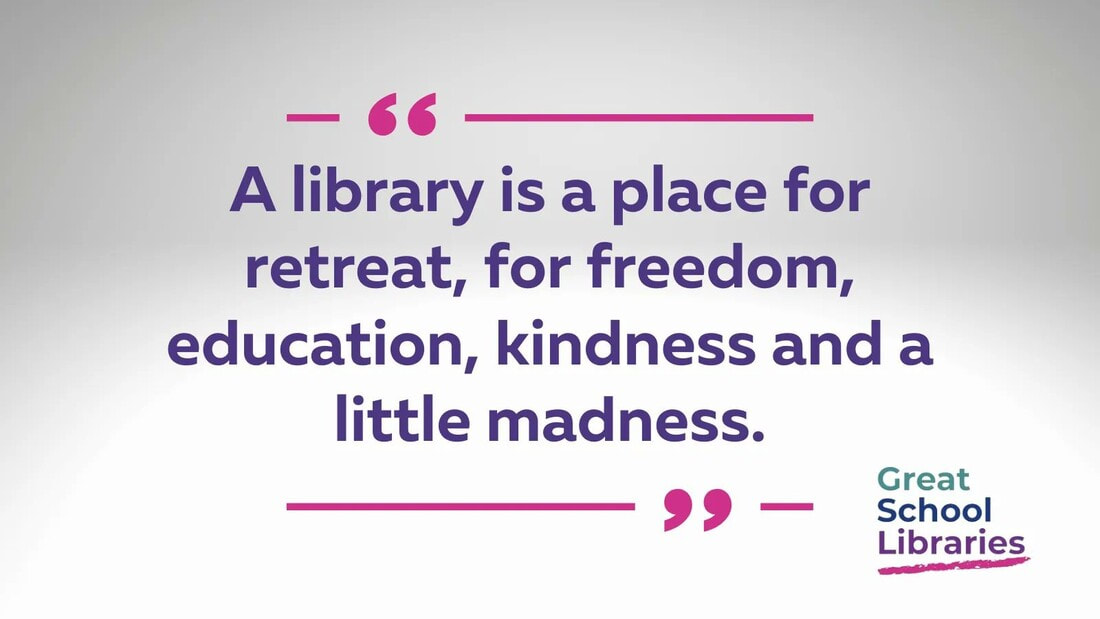 And we could all do with a little madness from time to time. Happy reading and please get in touch if you have any ideas, questions, comments or feedback for us. Nō reira, tēnā koutou, tēnā koutou, tēnā koutou katoa Immediate Past President
We wish to acknowledge Sasha Eastwood who made a massive contribution to SLANZA in her tenure as President, selflessly heading and working on multiple projects to strengthen SLANZA and support school librarians and school libraries throughout Aotearoa. Three examples of her biggest achievements include the NZEI Pay Equity Campaign, building relationships and opportunities through the New Zealand Libraries Partnership Programme, strategic partnerships with library sector stakeholders, and the Governance Review. As immediate Past President, Sasha has taken on the lead in the SLANZA Research Project. Her commitment and dedication to SLANZA is truly inspiring and we are indeed fortunate to have her level of knowledge and experience. LIANZA/SLANZA WEBINAR - LIBRARY AND INFORMATION QUALIFICATION GRANTS FOR SCHOOL LIBRARY STAFF21/8/2023  Tuesday, September 05, 3.30PM - 4.30PM
Join us to LEARN more about LIANZA and SLANZA Tertiary Grant funding to support library and information qualifications. These grants provide people working in, or new to, the library and information sector, with funding towards the costs of a library and information sector qualification. A new priority for funding in the 2023 funding round is for grants to school library staff starting a library and information qualification. This webinar will give you an opportunity to ask questions and learn about these grants to help you in your career. A new round of tertiary grants opens from October 4-23, 2023. For more information go here: https://www.librariesaotearoa.org.nz/grants-for-library-qualifications.html Presenters: · Sasha Eastwood - SLANZA and project advisory group member · Saskia Hill - Cashmere High School Library Manager and grant recipient · Kirsten Taylor or Stephanie Gillbanks - Perpetual Guardian REGISTER HERE https://lianza.wildapricot.org/event-5389887 Angela Cairncross | Communications Advisor LIANZA -Te Rau Herenga o Aotearoa I work Monday-Thursday P: 0212228076  A new round of tertiary grants towards a new library and information qualification opens from October 4-23, 2023. A new priority for funding in this round is for grants to school library staff starting a library and information qualification. Applicants are encouraged to apply for the grant this year as the opportunity may not be available in future years. Grants are available for tertiary qualifications for careers in public, school, tertiary, national and special libraries, and whānau, iwi and marae collections of taonga tuku iho. We encourage you to share information about these grants so your communities and staff have the opportunity to apply. School library staff talk in this video about what library and information qualifications mean for them and how the grants can help. Find out more here: https://www.librariesaotearoa.org.nz/grants-for-library-qualifications.html
You can get more information here: https://www.librariesaotearoa.org.nz/grants-for-library-qualifications.html Angela Cairncross | Communications Advisor LIANZA -Te Rau Herenga o Aotearoa I work Monday-Thursday P: 0212228076 NZ School Library Week 2023 We hope everyone has something planned for New Zealand’s school library week coming up. If you have not had time to put together a dashboard, we have great news! Accessit has created a dashboard for School Library Week. There are links to SLANZA’s downloadable resources such as bookmarks, posters and more. We have links to authors, and have created some quizzes at different levels – remember you can remove or edit any of the news items to suit your school. Go to ALeC to download your dashboard. 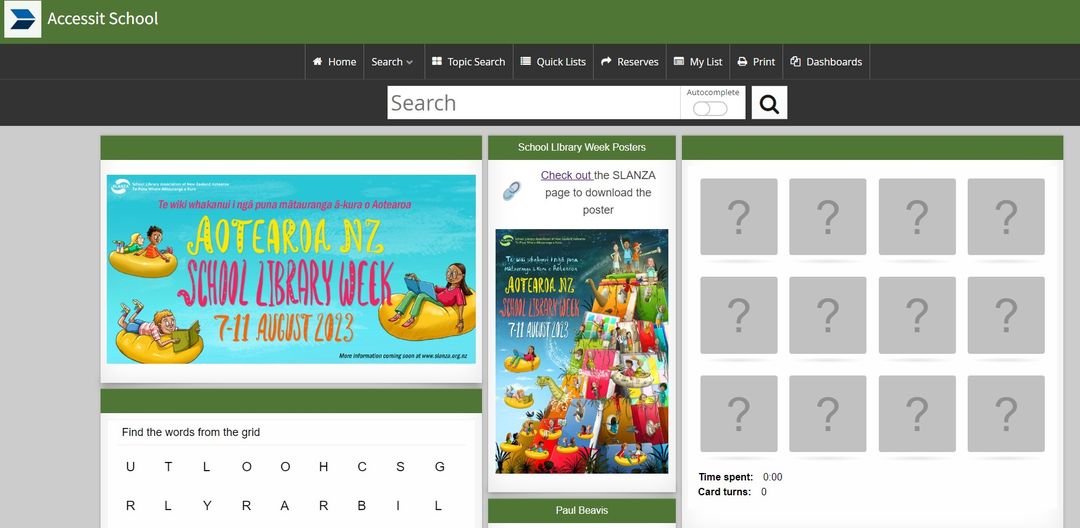 Celebrate knowledge and imagination - Aotearoa’s School Library Week is happening next week.3/8/2023 School Library Association of New Zealand Aotearoa, SLANZA - Te Puna Whare Mātauranga a Kura, instigated Aotearoa NZ School Library Week to celebrate the valuable role school libraries have in education and to acknowledge the work of school librarians.
The inaugural event was a resounding success, and we are thrilled to once again celebrate the joy of reading, learning, and imagination. This year, the event will be held from 7 – 11 August. A plethora of exciting activities can be found on the SLANZA website, specifically designed by SLANZA and award-winning illustrator Paul Beavis, to help kura across Aotearoa celebrate their library spaces. Schools are encouraged to share School Library Week-inspired activities via social media using the #AotearoaSchoolLibraryWeek hashtag. Celebrating Aotearoa NZ School Library Week raises the profile of school libraries. It normalises the need for our tamariki to have access to this valuable resource. National and international research has shown the importance and necessity of having a school library, supported by a specialist librarian with an adequate budget, in improving student achievement, well-being, literacy, and in building information literacy, critical thinking and a love of life-long reading. We hope Aotearoa NZ School Library Week will provoke discussions on the correlation between Aotearoa’s crisis in declining literacy rates among our children and teenagers, and that fewer than a third of schools and kura in Aotearoa have paid library staff. Let’s come together to support our young readers, and reinforce the importance of the school library as a centre of knowledge and creativity. Mark it on your calendars and get ready for an inspiring and imaginative week ahead. For more information, visit the SLANZA website, www.slanza.org.nz Contact: Sarah Stretch – SLANZA National Administrator - admin@slanza.org.nz |
Categories
All
Archives
April 2024
|
 RSS Feed


